Introduction
Wand massagers entered the market through a legal loophole. Marketed as “personal massagers” for neck and back relief, they were sold in drugstores and department stores — channels that wouldn’t touch a product labeled “vibrator.” That label stuck, and it still affects how platforms categorize wands, how payment processors evaluate them, and how buyers keyword their listings.
The category has since outgrown its camouflage. Wand massagers now command the highest motor power in the vibrator category — 1.5 to 3.0 watts, two to three times the output of a standard bullet or rabbit — and a price band stretching from 12entry−levelministo150+ full-size cordless models. They’re gender-neutral, accessory-compatible, and carry the lowest return rate among powered adult products because the value proposition is unambiguous: power and reliability.
This guide breaks down full-size versus mini, corded versus cordless, price tiers, market preferences, and the quality issues specific to wand construction. If you’re new to adult toy materials, read our materials guide first — the wand head material choice directly determines regulatory exposure and product lifespan.
Why Do Wand Massagers Outsell Expectations?
Buyers sometimes treat wands as a niche sub-category. That’s a mistake. Here’s what the sales data tells you.
Motor power drives purchase decisions. Wand motors operate at 1.5–3.0W and 3,000–6,300 RPM — roughly double the output of a standard rabbit vibrator motor. For a significant segment of consumers, power is the only spec that matters. Wands win that spec by a wide margin.
The “personal massager” label opens retail channels. Many general retailers, marketplaces, and payment processors have category restrictions on “sex toys” but permit “personal massagers.” A wand in neutral packaging with body-massage positioning can enter distribution channels that are closed to explicitly branded adult products. This isn’t a hack — it’s a market access strategy.
Gender neutrality expands the addressable market. A rabbit vibrator sells to women. A masturbator sells to men. A wand massager sells to both — and to couples. One SKU covers a wider demographic than almost any other powered product in the category.
Accessories create recurring revenue. A wand with a replaceable silicone head supports an attachment ecosystem: textured heads, internal-use attachments, couple-use attachments, and travel cases. The wand is the platform. The attachments are the repeat purchases.
Price band width allows tier stacking. You can stock a 6FOBentry−levelmini,a18 FOB mid-tier full-size, and a $35 FOB premium cordless without cannibalization. Few categories allow three distinct price tiers with clear feature differentiation at each level. Wands do.
Full-Size vs Mini Wand: Which Form Factor for Which Market?
The size difference between a full-size wand and a mini wand isn’t cosmetic. It changes the motor housing, the battery capacity, the heat dissipation design, and the retail channel fit.
Full-Size Wand
The standard wand form factor: 28–35 cm in length with a head diameter of 50–65 mm. The larger body accommodates a physically bigger motor — typically 1.5–3.0W with a rotational speed of 3,000–6,300 RPM. The handle houses the battery (for cordless models) and the control PCB.
Advantages:
- Highest motor power in the vibrator category
- Longest battery life for cordless models — more space for a larger battery
- Strongest brand recognition — the silhouette is iconic
- Best platform for accessory ecosystems
Disadvantages:
- Bulky — not travel-friendly, takes significant retail shelf space
- Heavier — 250–500g, which matters for shipping cost and consumer fatigue
- Noise floor higher — 55–65 dB at full speed is typical
BOM cost: 8–18(corded)/12–25 (cordless) Retail price: 30–60(corded)/50–150 (cordless) Best markets: US, UK, Australia — markets where power is the primary purchase driver
Mini Wand
Compact form factor: 15–22 cm in length with a head diameter of 35–45 mm. The smaller body means a smaller motor — typically 0.8–1.5W — and a smaller battery. Power output is lower, but so is noise and shipping weight.
Advantages:
- Portable and discreet — fits in a travel bag or small retail display
- Lower noise — 45–55 dB at full speed
- Lower shipping cost per unit
- Appeals to first-time buyers intimidated by full-size models
Disadvantages:
- Lower power — won’t satisfy users who prioritize intensity
- Shorter battery life — smaller battery in a smaller body
- Less accessory compatibility — non-standard head sizes limit attachment options
BOM cost: 5–10∗∗Retailprice∗∗:15–40 Best markets: Japan (compact preference), Southeast Asia (price-sensitive), travel retail
Comparison at a Glance
| Specification | Full-Size Wand | Mini Wand |
|---|---|---|
| Length | 28–35 cm | 15–22 cm |
| Head diameter | 50–65 mm | 35–45 mm |
| Motor power | 1.5–3.0W | 0.8–1.5W |
| RPM range | 3,000–6,300 | 2,000–4,500 |
| Noise level | 55–65 dB | 45–55 dB |
| Weight | 250–500g | 100–200g |
| BOM cost | $8–25 | $5–10 |
| Retail price | $30–150 | $15–40 |
The decision between full-size and mini is a market-fit decision, not a quality decision. A well-made mini wand with a 1.5W motor and IPX6 waterproofing outperforms a poorly made full-size wand with a 1.2W motor. Judge the spec sheet, not the silhouette.
Corded vs Cordless: What Are You Trading Off?
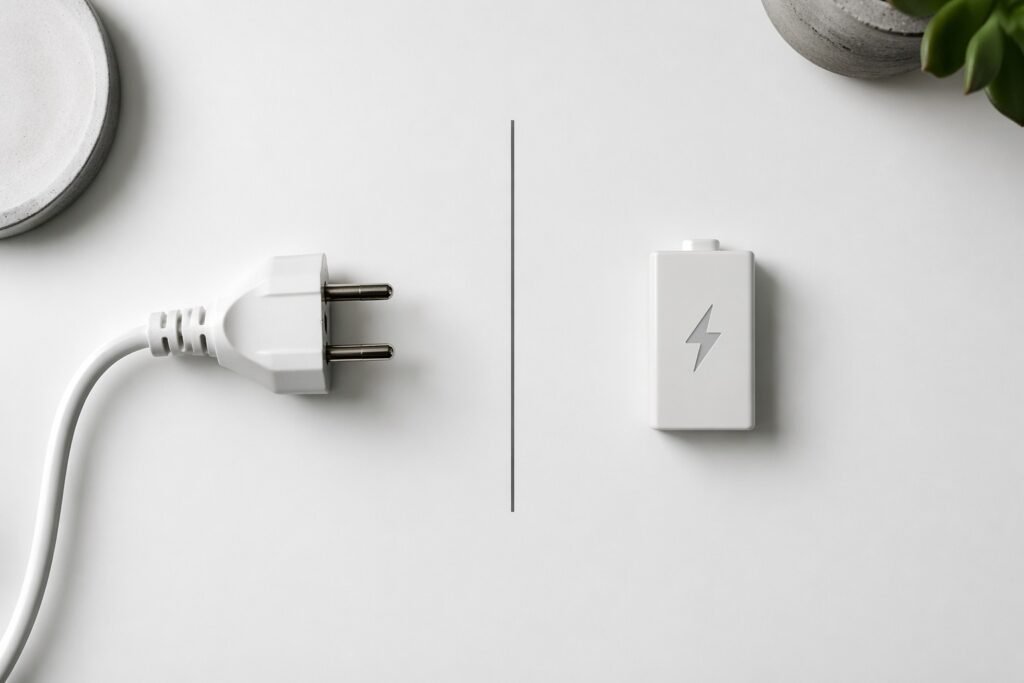
The power source decision is the second-largest cost and performance variable after the motor itself.
Corded Wand
A corded wand plugs directly into wall power. The motor draws current directly from the mains through an AC-to-DC converter in the handle or a wall adapter. There is no battery to charge, no runtime limit, and no power degradation over the session.
Advantages:
- Unlimited runtime — the motor never throttles due to low battery
- Constant power output — no voltage drop as the battery drains
- Lowest BOM cost — no battery, no charging circuit, no battery management IC
- No battery aging — product lifespan is mechanical, not electrochemical
Disadvantages:
- Tethered to an outlet — limits where and how the product is used
- Typically not waterproof — AC power and water don’t mix without expensive sealing
- Plug and voltage standards vary by country — US (Type A/B, 110V), EU (Type C/F, 220V), UK (Type G, 230V). Each market needs its own SKU or a universal-voltage adapter.
Best for: Budget full-size lines, US and UK traditional markets, consumers who prioritize reliability over portability.
Cordless (Rechargeable) Wand
A rechargeable wand runs on an internal lithium-ion battery, typically 3.7V with capacities from 800 mAh (mini) to 2,600 mAh (full-size). Power is drawn from the battery through a boost converter to drive the motor at higher voltage.
Advantages:
- Portable — no cord, use anywhere
- Waterproof achievable — IPX6 and IPX7 are realistic with proper charging port sealing
- Modern retail preference — cordless products dominate new listings
- Gift-friendly — no cable clutter in the box
Disadvantages:
- Limited runtime — 40–90 minutes depending on speed setting and battery capacity
- Power degrades as battery discharges — the last 20% of battery life delivers noticeably weaker output
- Battery aging — capacity declines after 300–500 charge cycles
- Higher BOM cost — battery cell, charging circuit, and battery management system add $3–6
- Lithium battery shipping — requires UN38.3 test certification for air and sea freight. Covered in detail in our certification and compliance guide.
Comparison at a Glance
| Feature | Corded Wand | Cordless Wand |
|---|---|---|
| Power stability | Constant | Degrades with battery level |
| Runtime | Unlimited | 40–90 minutes |
| Waterproofing | Rarely waterproof | IPX6–7 achievable |
| Portability | Poor — outlet-dependent | Excellent |
| BOM cost adder | Baseline | +$3–6 |
| Shipping | Standard | Requires UN38.3 |
| Lifespan | Mechanical only | Mechanical + battery aging |
| Retail preference trend | Declining | Dominant |
If you’re stocking one wand, make it cordless. If you’re stocking two, make one corded for the budget tier and one cordless for the premium tier. The corded market exists and will continue to exist — it’s just smaller than the cordless market and shrinking.
What Makes a Good Wand Head?
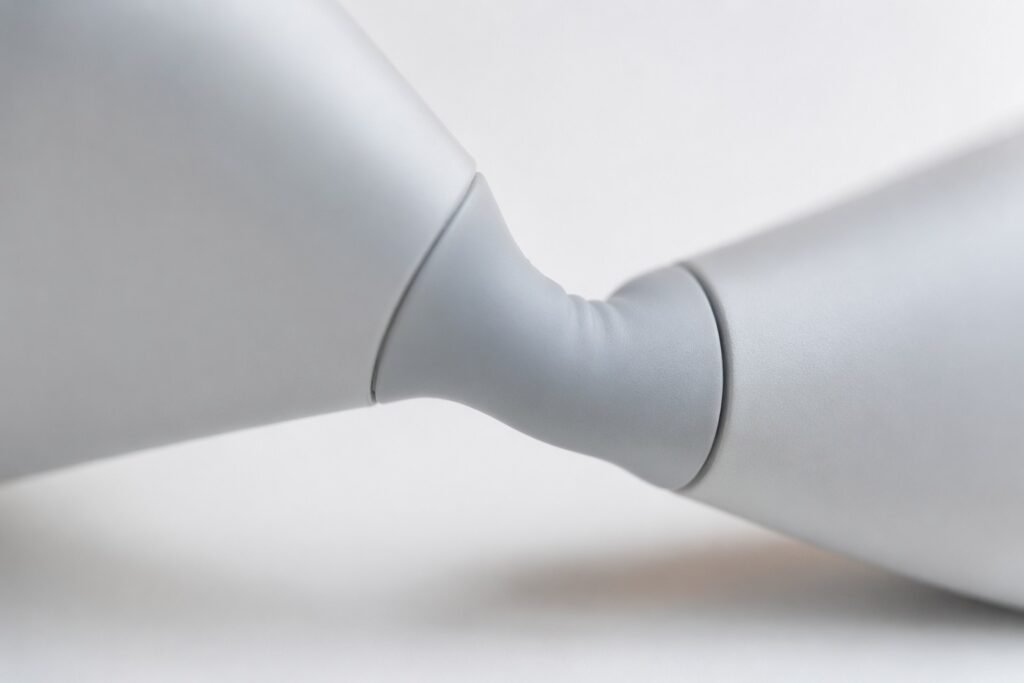
The wand head is the only part of the product that contacts the user’s body. Every other component exists to drive this one component. Get it right.
Material. The head must be platinum-cured silicone. TPE heads degrade rapidly under the combination of high-frequency friction from the motor and continuous contact with lubricants. A TPE head on a 2.5W motor will start leaching oil and losing surface integrity within weeks. Silicone heads last the life of the product. For material verification methods, see Tests 1–3 in our sample testing checklist.
Size. Full-size wand heads should be 55–65 mm in diameter. Under 55 mm and the surface area is too small for the motor’s power — the vibration concentration becomes uncomfortable rather than effective. Over 65 mm and the head is unwieldy, increases shipping dimensional weight, and limits accessory compatibility.
Replaceability. A wand head that can be removed and replaced opens an accessory revenue stream and extends the product’s useful life. The interface between head and body should be standardized — a threaded collar or a bayonet mount with tight tolerances. A loose head rattles at high speed and generates noise complaints. A non-removable head turns a 2siliconedegradationproblemintoa40 product replacement.
Neck flexibility. The flexible neck connecting the wand head to the handle is the most mechanically stressed component in the entire product. It absorbs vibration energy that would otherwise transmit to the handle and the user’s hand. If it’s too stiff, the handle vibrates uncomfortably. If it’s too soft or poorly constructed, it cracks after repeated flexing.
The neck is where wand samples most commonly fail. Test it by bending the head to 90 degrees from the handle axis, holding for 10 seconds, and releasing. Repeat 20 times. Any cracking sound, visible stress marks, or reduced spring-back is a fail — and a structural failure at this point means the head detaches from the product body during use, which is a safety incident, not a warranty claim.
What Are the Price Tiers and Margin Structures?
Wand pricing splits cleanly into five tiers. The cost driver between tiers isn’t just the motor — it’s the combination of motor power, battery capacity, waterproof rating, and head design.
| Tier | Configuration | FOB Price | Retail Price | Gross Margin |
|---|---|---|---|---|
| Entry Mini | Single speed, USB charge, basic silicone head | $5–10 | $12–25 | 58–62% |
| Mid Mini | Multi-speed, IPX6, replaceable head | $10–15 | $25–40 | 60–65% |
| Entry Full-Size | Corded, multi-speed, flexible neck | $8–18 | $30–60 | 65–70% |
| Mid Full-Size | Cordless, 10+ patterns, IPX6, replaceable head | $18–25 | $60–100 | 68–73% |
| Premium Full-Size | Cordless, app control, IPX7, memory settings | $25–40 | $100–150 | 72–78% |
The margin structure is attractive across all tiers, but the absolute dollar profit per unit jumps significantly at mid-tier and above. A mid-tier full-size wand at 22FOBand80 retail returns 58grossperunit.Anentry−levelminiat7 FOB and 18retailreturns11. You need to sell five minis to match the gross profit of one mid-tier full-size wand — and the return rate on the full-size product is lower.
The BOM cost difference between an entry-level mini and a mid-tier full-size wand breaks down as:
- Larger motor (+$2–3)
- Lithium battery vs no battery (+$3–5)
- Silicone head with replaceable interface vs fixed TPE head (+$2–4)
- Multi-button control PCB vs single-button (+$1)
- Retail packaging vs white box (+$1–3)
If a supplier quotes a mid-tier spec at an entry-tier price, check the motor wattage and the head material — those are the two line items where cost cutting is invisible until the product fails.
What Sells Where? Market-by-Market Breakdown
Wand preferences vary more by market than most buyers expect.
| Market | Preferred Form | Price Range | Key Requirements |
|---|---|---|---|
| United States | Full-size, cordless | $50–120 retail | Highest power, 10+ patterns, IPX7, replaceable head |
| UK / Europe | Full-size + mini balanced | £30–80 retail | Low noise, CE + UKCA, elegant design, eco-packaging |
| Australia | Full-size, cordless | AUD 60–150 | RCM certification, cordless preferred, IPX7 |
| Japan | Mini dominant | ¥3,000–8,000 | ≤45 dB, compact size, refined colors, premium unboxing |
| Middle East | Mini, discreet | $20–40 retail | Quiet, conservative packaging, emerging halal requirement |
| Southeast Asia | Mini, budget | $10–25 retail | Colorful, portable, basic waterproof, price-sensitive |
US market: Power isn’t a preference — it’s the requirement. A 1.5W wand competes on price alone. A 2.5W+ wand competes on performance. Cordless has overtaken corded in US retail; if you’re stocking corded, position it as a budget option only.
EU market: Noise is the differentiator. A wand that runs at 58 dB in Germany or the Netherlands generates returns. British consumers are the exception — they track closer to US preferences for power. Recyclable packaging and CE/UKCA dual compliance are baseline expectations, not premium features.
Japan market: Japanese consumers will pay more for less noise and less size. A mini wand at 42 dB and 18 cm length retails successfully at ¥5,000–8,000 — the same retail price as a mid-tier full-size wand in the US. Do not send full-size wands to Japan as a first shipment. Start with mini, prove fit, then test full-size.
Middle East: Outer packaging must be discreet — no product imagery, neutral product description. Halal certification is emerging as a retailer requirement in the Gulf and Southeast Asia. It applies to materials and lubricants that contact the body. Build it into your compliance budget early rather than retrofitting later.
What Are the Most Common Wand Quality Issues?
Wand massagers fail in predictable ways. Most failures are detectable during sample testing if you know what to look for.
| Issue | Test Reference | Impact |
|---|---|---|
| Flexible neck cracks after repeated bending | Test 10 — bend test (20 cycles minimum) | Structural failure → safety incident |
| Battery runtime under 40% of spec | Test 4 — charge and runtime test | False capacity claim → mass returns |
| Head silicone bleeds oil on paper | Test 2 — oil bleed test | Material fraud → compliance disaster |
| Noise exceeds 65 dB at full speed | Test 7 — noise test | Top-3 return reason for all vibrators |
| Charging takes 4+ hours for a full charge | Test 4 — charge time | Poor user experience → negative reviews |
| Corded plug loose in socket, intermittent power | Physical inspection, wiggle test | #1 return driver for corded wands |
| Charging port cover doesn’t seal | Test 5 + Test 11 | Water ingress → functional failure |
Full methodology for each test is documented in our sample testing checklist.
The flexible neck is the wand-specific vulnerability. No other adult product has a component that bears repeated mechanical stress at a single flex point the way a wand neck does. Factory samples that pass every other test can fail the neck test within 10 cycles. Require a 20-cycle minimum during sample evaluation. If the neck shows any degradation — sound, feel, visible stress — reject the sample. A neck failure in consumer use means the powered head separates from the handle. That’s not a bad review. That’s a liability claim.
Do Wand Accessories Generate Real Revenue?
Yes. Wand attachments are one of the highest-margin accessory categories in adult retail.
Replaceable silicone heads are the natural upsell. A wand customer buys the product once. If the head is removable, they buy replacement heads — textured, contoured, different firmness levels — indefinitely. Stock two to three attachment SKUs alongside every wand SKU. BOM cost on a silicone attachment head is 1–3.Retailis10–25. The margin is higher than the wand itself.
Universal vs proprietary interface is a strategic decision. A proprietary head mount locks customers into your attachment ecosystem — higher lifetime value, but a smaller total addressable market. A universal mount (compatible with industry-standard thread patterns) means your wand works with third-party attachments — wider appeal, but you don’t capture the attachment revenue. Choose based on your brand strategy, not factory convenience.
Storage cases and travel bags are zero-complexity add-ons. A neoprene or EVA case with a molded insert costs 1–3BOMandretailsat10–20. Add it to the purchase order — it ships in the same carton and adds margin at zero additional logistics cost.
Procurement tip: Order attachments on the same PO as the wands. The combined carton weight qualifies for better freight rates than separate shipments, and the attachments fill dead space in the wand carton.
What Are the MOQ and Customization Options?
Standard wand MOQ: 60 units per carton. Mixed-carton orders accept 10 units minimum per SKU per color.
For a detailed breakdown of mixed-carton rules and volume pricing, see our MOQ and wholesale pricing guide.
OEM customization (your brand on an existing mold): 1,000 units minimum. Customizable: wand color, head color, logo placement, packaging, button layout, and control interface printing. Lead time: 3–5 weeks.
ODM customization (new mold, your design): 1,000 units minimum, mold fee $2,000–5,000. Lead time: 4–8 weeks for mold fabrication plus production. ODM gives you exclusive mold rights and full design control — head shape, handle ergonomics, neck geometry, and button interface are all yours.
Common customization requests from AmorSerere clients:
- Head color and texture pattern
- Handle finish — matte silicone overmold vs glossy ABS
- Neck color matched to brand palette
- Button layout and tactile feedback
- Packaging from white box to magnetic-close gift box with foam insert
- Branded travel case included in-box
The Bottom Line
A wand massager is closer to a small appliance than a disposable consumer product. Customers expect it to work every time, at full power, for years. They don’t treat it as an impulse purchase — they research, compare, and buy the one they think will last.
That means the sourcing logic for wands is different from other adult toy categories. You’re not sourcing the cheapest unit that meets a spec. You’re sourcing the unit with the lowest return rate and the highest customer retention.
Prioritize motor power and head material over cosmetic features. Test the neck until it breaks or proves it won’t. Stock cordless over corded unless you have a specific budget-segment strategy. And always, always stock attachments — the wand is the platform. The accessories are the profit.
Sourcing wand massagers for your market? Contact AmorSerere for product recommendations and wholesale pricing →