
Introduction
A buyer I know ordered a full container of TPE vibrators from a factory that swore their material was “EU compliant.” Three weeks after arrival, the shipment was flagged at Rotterdam customs for exceeding phthalate limits under REACH. The entire container was rejected. He lost $47,000 in product cost alone — not counting freight, warehousing, and three months of downtime.
Material choice isn’t a product design decision. It’s a compliance decision, a margin decision, and a reputation decision wrapped into one. Pick wrong, and you’re not dealing with a bad review — you’re dealing with customs rejection, chargebacks, and inventory you legally can’t sell.
This guide covers the four material families in adult toy manufacturing: what they cost, what they’re safe for, what markets accept them, and what to ask a supplier before you commit to a production run. No consumer fluff. No marketing adjectives. Just what a buyer needs to know.
If you’re new to adult toy import regulations, read our import compliance guide first — it covers the customs framework this article assumes you understand.
Medical-Grade Silicone: When Should You Pay the Premium?
Platinum-cured silicone is the highest standard in adult product manufacturing. It costs 3–5× more than TPE at the raw material level, and that premium buys you safety, durability, and regulatory clearance that cheaper materials simply can’t deliver.
Cost and Production
Raw platinum-cured silicone runs 8–15/kgdependingonshorehardnessandformulation,versus2–4/kg for TPE. A 200g silicone dildo carries $1.50+ in raw material cost before any manufacturing overhead. That cost compounds across every unit, but so do the benefits.
The premium is justified for:
- Insertable products (vaginal and anal — direct mucosa contact)
- Any SKU marketed as “body-safe” or “medical grade” in regulated markets
- Premium product lines where a material-related return would wipe out the per-unit margin entirely
Consult our MOQ and wholesale pricing guide for production batch economics that account for material-grade cost differences.
Safety Profile
Platinum-cured silicone is non-porous, hypoallergenic, and chemically inert. It doesn’t leach plasticizers, doesn’t degrade into anything toxic, and doesn’t support bacterial growth — properties no TPE formulation can match.
Two reference standards every buyer should know:
- FDA 21 CFR 177.2600: The US regulation covering rubber articles intended for repeated contact with aqueous and fatty foods. While the FDA exercises enforcement discretion over adult products (they don’t formally “certify” them), silicone meeting this standard is considered compliant for the US market.
- ISO 10993: The international standard for biological evaluation of medical devices. A factory with ISO 10993 test reports for their silicone can prove biocompatibility — no skin irritation, no cytotoxicity, no sensitization.
The “Medical Grade” Trap
“Medical grade” and “food grade” silicone are not the same thing. Food-grade silicone has lower extraction limits and is sometimes sold by factories as “close enough to medical grade.” It’s not. When a supplier says “medical grade,” your only response is: “Show me the third-party test report.”
An SGS, TÜV, or Bureau Veritas lab report carries weight. A factory’s own declaration does not.
Silicone lasts 5+ years with no degradation, no oil seepage, and no color change. Products don’t come back because the material failed. In a product category where returns often exceed 10%, that reliability is real margin protection.
TPE / TPR: Where Does the Cost Savings Come From — and What Are You Trading Away?
TPE (thermoplastic elastomer) and TPR (thermoplastic rubber) are the budget workhorses of adult toy manufacturing. They’re cheap, they’re soft, and they feel good out of the box. The problems show up later — and they’re the kind of problems that generate returns, complaints, and regulatory exposure.
The Cost Advantage
Raw TPE costs $2–4/kg — one-third to one-fifth the cost of silicone. For a budget product line targeting price-sensitive markets, TPE can be the difference between a viable margin and no margin at all. Every factory knows how to mold it, and the supply chain is mature.
The Three Problems You Can’t Ignore
Porosity. TPE is microscopically porous. Bacteria, lubricant residue, and body fluids penetrate the surface and cannot be fully cleaned out. This isn’t a hygiene opinion — it’s a material property. Products made from TPE should not be marketed for internal use. If you’re selling into markets with strong consumer protection laws, labeling TPE products as “body-safe” opens you to liability.
Oil seepage and odor. TPE relies on plasticizers for its soft feel. Over 6–12 months of shelf life, these plasticizers migrate to the surface. The product becomes sticky, develops a chemical smell, and leaves oil stains on packaging. A buyer unboxes a unit that’s been sitting in a warehouse for eight months — it looks like it’s melting. That’s a return, and returns on opened adult products are almost always a total loss.
Phthalates and regulatory risk. DEHP, DBP, BBP, and DIBP — the four phthalates restricted under EU REACH at concentrations above 0.1% by weight — are common in standard TPE formulations. California’s Prop 65 requires warning labels for products containing listed phthalates. The Rotterdam container rejection story in the introduction? TPE with undeclared phthalates.
When TPE Makes Sense
TPE is appropriate for:
- External-use products only: masturbators, strokers, penis sleeves
- Budget-tier lines where the price point justifies a shorter lifespan
TPE is not appropriate for:
- Any insertable product
- Any SKU destined for the EU without certified phthalate-free TPE and batch-level REACH documentation
- Any brand positioning above budget tier
Phthalate-free TPE formulations exist but cost more and are not what most factories stock by default. If you’re buying TPE for the EU market, “phthalate-free” needs to be on the purchase order, confirmed by a lab report per batch. Verbal assurance from a sales rep is worth zero at customs.
ABS Plastic: Why Is It the Standard for Hardware?
ABS (acrylonitrile butadiene styrene) is the default material for rigid components: vibrator housings, control handles, bullet shells, remote controls, and structural frames. It’s cheap ($2–5/kg), strong, molds with tight tolerances, and is inherently body-safe — non-porous, non-allergenic, and chemically stable.
The ABS + Silicone Standard
Most mid-range to premium vibrators use two-material construction: an ABS core or handle married to a silicone contact surface. This keeps the BOM cost manageable while putting body-safe material where it matters — at the point of contact.
When assessing an ABS + silicone product, check three things:
- Seam sealing: Where ABS meets silicone, is the junction waterproof? If water seeps in, bacteria follows. This directly determines the IPX rating.
- ABS grade: Food-contact-grade ABS is what you want. Generic industrial ABS may contain processing residues that become a compliance issue.
- Overmolding integrity: If silicone is overmolded onto ABS, check for delamination. Silicone peeling off plastic is a warranty claim waiting to happen.
ABS is globally accepted with zero market-specific restrictions. Compliance documentation is straightforward — RoHS for electronic products, general product safety declarations for non-electronic. It’s the lowest-regulatory-risk material in the category and the default choice for any rigid component.
Glass and Metal: Are They Worth the Freight Cost?
Borosilicate glass and stainless steel sit at the premium end. They’re beautiful, body-safe, and permanent. They’re also heavy, expensive to ship, and fragile — a combination that punishes thin margins.
Borosilicate Glass
Glass dildos and plugs retail at $40–120+ and appeal to a luxury-oriented buyer profile. The material is chemically inert, non-porous, and supports temperature play (heat or cold). From a material safety standpoint, it’s perfect.
From a logistics standpoint, it’s a headache:
- Budget 3–8% breakage on ocean freight and 5–15% on air freight depending on packaging quality
- Thicker packaging reduces breakage but increases dimensional weight — and therefore shipping cost
- Glass carries product liability exposure: if a unit fractures during consumer use, the injury is serious. Check your insurance coverage before adding glass SKUs.
Stainless Steel and Aluminum
Metal toys — primarily 316L stainless steel or 6061 aluminum — are used in BDSM products (restraints, weights, plugs) and ultra-premium dildos. The BOM cost is high, shipping weight makes freight expensive, and the addressable market is narrow.
For a buyer building a first product line: skip glass and metal. Focus on silicone, ABS, and selective TPE for external-use products. Add glass or metal only when you have the packaging infrastructure, insurance coverage, and market demand to justify the logistics cost.
Comparison at a Glance
| Material | Raw Cost | Safety Level | Target Markets | Logistics Risk | Recommended For | Lifespan |
|---|---|---|---|---|---|---|
| Platinum-Cured Silicone | $8–15/kg ($$$) | Highest — FDA 177.2600, ISO 10993 | US, EU, UK, AU, all premium | Low | Insertables, premium lines, mucosa-contact | 5+ years |
| TPE / TPR | 2–4/kg() | Medium-Low — porous, phthalate risk | Budget US, non-EU; EU only with certified phthalate-free | Low | External-use only: strokers, sleeves | 6–12 months |
| ABS Plastic | 2–5/kg() | High — inert, non-porous | Global, zero restrictions | Low | Housings, handles, bullet shells, frames | 5+ years |
| Borosilicate Glass | $5–15/unit ($$$) | Highest — inert, non-porous | US/EU premium niche | High (breakage) | Luxury dildos, temperature-play | Permanent* |
| Stainless Steel | $20–60/unit ($$$$) | High — 316L is medical grade | Niche BDSM, luxury | High (weight) | BDSM, premium plugs/weights | Permanent |
*Unless broken. Budget breakage into your landed cost model.
What Does Each Market Require for Material Compliance?
United States
The FDA exercises enforcement discretion over adult products — they don’t actively regulate them as medical devices, but they reserve the right to act on adulterated or misbranded products. Silicone products should reference FDA 21 CFR 177.2600 as the closest applicable standard.
California Proposition 65 requires warning labels for products containing listed phthalates or heavy metals. If your product moves through or sells into California, Prop 65 compliance is not optional.
European Union
Three regulations matter:
- REACH (EC 1907/2006) restricts DEHP, DBP, BBP, and DIBP at >0.1% concentration — this applies to all products, not just electronics.
- RoHS (2011/65/EU) restricts the same phthalates plus heavy metals in electrical/electronic products — your battery-powered and rechargeable SKUs fall under this.
- CE marking falls under the Low Voltage Directive (LVD) for plug-in products or the Radio Equipment Directive (RED) for Bluetooth/wireless products.
For a deeper dive, see our full certification and compliance guide.
United Kingdom
Post-Brexit, the UK runs its own parallel system:
- UK REACH: Same phthalate restrictions, separate registration.
- UKCA marking: Replaced CE marking, mandatory for products placed on the GB market from 2025.
EU compliance documentation does not automatically satisfy UK requirements. Factor this into your compliance budget.
Australia
Australia is relatively lenient for non-electronic products. For battery-powered products, AS/NZS 62368.1 applies to charging and battery systems. The ACCC enforces general consumer product safety obligations, but no adult-toy-specific material regulation exists.
Middle East and Southeast Asia
Halal certification is emerging as a purchasing requirement in Indonesia, Malaysia, and parts of the Gulf region for personal care and intimate products. This is a market access requirement, not a material safety standard. Verify with your importer whether halal certification applies to your product category before committing to production.
How Do You Verify a Supplier’s Material Claims?
A supplier’s verbal assurance means nothing. Here are three verification methods you can perform yourself — and one you should always require.
The Burn Test
Cut a small sample and light it. Real silicone burns cleanly with white-gray ash and faint, non-chemical smoke. The ash crumbles to powder. TPE or blended material melts, drips, and produces black smoke with an acrid smell. The residue is sticky and tar-like. This takes thirty seconds and catches the most common lie: “it’s silicone” when it’s actually a silicone-TPE blend.
The Oil Bleed Test
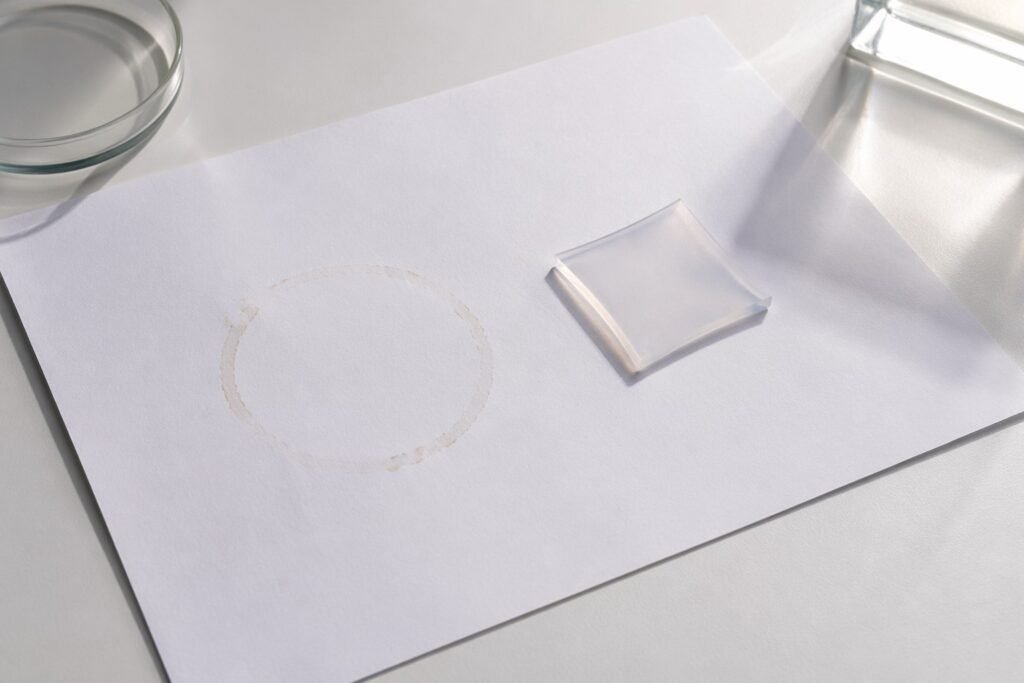
Place the product on white printer paper for 24 hours at room temperature. Good silicone leaves no trace. TPE or low-grade material leaves an oily ring or yellowish stain — exactly what happens on a warehouse shelf over months of storage, compressed into a day.
The Smell Test
Open the package and smell the product directly. Silicone has no odor or a faint neutral scent that disappears within minutes. TPE smells like a new shower curtain — a chemical, rubbery odor that persists. If it smells, it’s not silicone.
The Non-Negotiable: Third-Party Lab Reports
The only documentation that holds weight with customs and your insurer is a lab report from SGS, TÜV Rheinland, Bureau Veritas, or Intertek. Request these specifically:
- Material composition report — identifies grade and formulation
- REACH compliance certificate — EU-bound products
- RoHS compliance certificate — electronic products
- FDA 21 CFR 177.2600 test report — silicone for US market
- Batch consistency declaration — confirms current production matches tested sample
If a factory can’t produce these within 48 hours of your request, treat the material as unverified until they can. No exceptions.
Five Questions to Ask Before You Place the Order
- “What grade of silicone are you using? Provide the third-party test report from SGS, TÜV, or BV.”Sieves out factories using silicone-TPE blends and calling them “medical grade.” If they can’t name the grade, they’re not using medical-grade silicone.
- “Does your TPE contain DEHP, DBP, BBP, or DIBP? Show me the REACH certificate for this batch.”Phthalate-free TPE exists. Most factories don’t stock it unless the buyer demands it explicitly. Ask before, not after.
- “Is this material compatible with both water-based and silicone lubricant?”Silicone lube can degrade some silicone products over time. Your packaging and product page need clear lubricant compatibility instructions. Don’t leave this for the consumer to guess.
- “What’s your batch-to-batch material consistency guarantee?”Factories change material suppliers mid-production to save cost. Your purchase order should include a clause requiring prior notification and re-testing for any material source change.
- “Provide the Material Safety Data Sheet (MSDS) and full ingredient disclosure for this formulation.”The MSDS tells you what’s in the material and what hazards exist during manufacturing, handling, and end use. Any factory that hesitates to provide one is hiding something — walk away.
The Bottom Line
Material choice has the longest tail of any decision in adult toy sourcing. A bad design can be iterated. A bad price can be renegotiated. A bad material choice becomes returns, regulatory action, and inventory write-offs — costs that compound across every unit you sell.
- Silicone for anything that goes inside the body. Pay the premium.
- ABS for housings and hardware. It’s cheap, safe, and globally accepted.
- TPE only for external-use products, and only with batch-level REACH documentation.
- Glass and metal only when you’ve built the logistics and insurance to support them.
Your material spec sheet is your margin protection. Get it right before production starts, and you won’t have to fix it after the container lands.
Need help evaluating material options for your product line? Contact AmorSerere for a free sourcing consultation →