Author: Linda Zhang Date: July 9, 2026 Reading Time: 9 minutes
Introduction: The Flight You Don’t Need to Take
A buyer once told me he was about to spend $3,800 on a flight to Shenzhen to “see the factory with his own eyes.”
I asked him three questions:
- “Have you received samples from them?”
- “Have you done a live video call walking through the production floor?”
- “Do you have their certifications with verifiable registration numbers?”
His answers: yes, no, and no.
“Before you spend four thousand dollars on a plane ticket,” I said, “let me show you what you can verify from your desk for free.”
He did not book the flight. Two weeks later, he placed his first order—after completing the remote vetting process I am about to share.
Flying to China is not the only way to verify a supplier. For most first-time orders under $20,000, it is not even the best way. A plane ticket buys you two days on the ground. A structured remote vetting process buys you ongoing visibility. This guide explains how to do it.
A Note on Company Names in Chinese Manufacturing
Before we get into the checklist, something that confuses many first-time buyers: the company name on the website, the company name on the business license, and the company name on the bank account may all differ. This is not automatically a red flag.
In China’s export manufacturing industry, it is normal for a factory to operate under multiple registered entities—one for domestic production, one for international trade, one for brand licensing. Tax structures, export licenses, and banking requirements often make a single-entity setup impractical.
The question is not “do all the names match?” It is “can the supplier explain clearly why they don’t?”
A legitimate supplier will provide a straightforward explanation. A supplier who dodges the question is the one you should worry about.
Part 1: The Five Things You Must Verify Before Any Payment
| Verification | What It Tells You |
|---|---|
| Certification Documents | Are FDA/CE/ISO claims backed by real certificates with verifiable registration numbers? |
| Live Video Tour | Is the production facility real, operating, and consistent with its claimed scale? |
| Sample Quality | Does the physical product match the catalog photos and specifications? |
| Export Track Record | Has this company shipped to regulated markets before? |
| Communication Quality | Are your questions answered clearly, consistently, and in detail? |
If a supplier passes all five, you are in the top tier of verified partners. If they resist any of these checks, you have your answer without ever leaving your desk.
Part 2: How to Verify Certification Claims
“I have FDA certification” is the most overused and under-verified claim in international trade.
The distinction that matters:
| Claim | What It Means | How to Verify |
|---|---|---|
| “FDA Registered” | The manufacturing facility has registered with the FDA | Ask for the FDA Establishment Registration number. Verify it on the FDA’s public database |
| “FDA Approved” | The FDA has reviewed and cleared a specific medical device | Almost no adult toy has FDA approval. If a supplier claims this, they are either lying or confused |
| “CE Certified” | The product meets EU safety requirements | Ask for the Declaration of Conformity and the testing laboratory’s name |
| “ISO 13485 Certified” | The factory’s quality management system meets medical device standards | Ask for the certificate number and issuing body. Verify through the certification body’s public registry |
A legitimate manufacturer will provide the certificate number and issuing body without hesitation. A manufacturer with something to hide will send you a screenshot with the identifying numbers cropped out—or “cannot find” the certificate when you ask for the original.
Part 3: The Live Video Tour Protocol
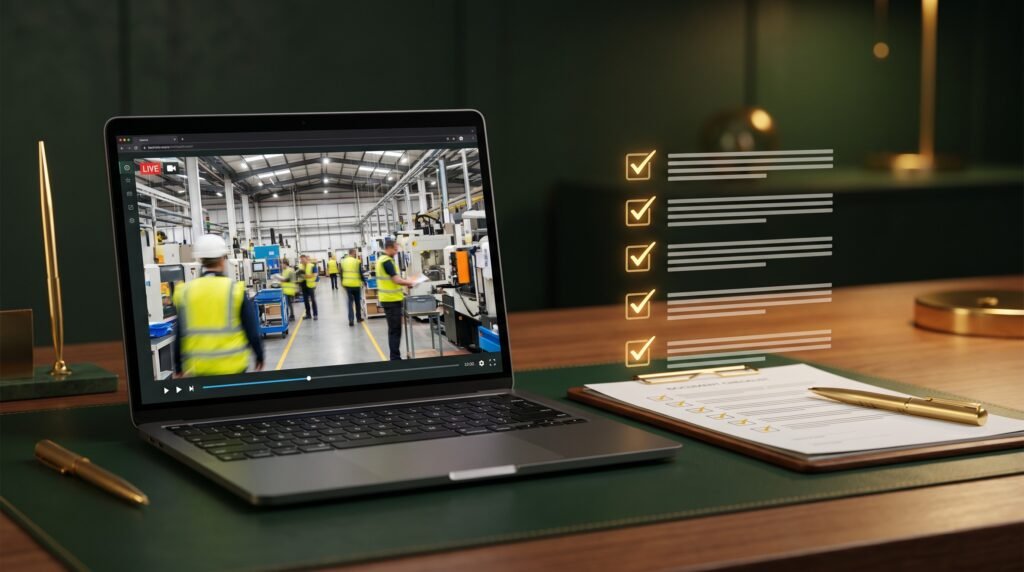
A recorded factory video is a marketing asset. It can be edited, staged, or filmed at a different facility. A live video call is a verification tool.
How to request it: “Before we proceed with the order, could we do a brief video walkthrough of the production floor? 15 minutes, any time that works for you.”
A legitimate operation will say yes. A company with no real production capability will make excuses—”management policy,” “confidentiality concerns,” “the factory floor is closed for maintenance.”
What to Look For on the Call
| Observe This | What It Tells You |
|---|---|
| Machines actually running | Static displays mean nothing. Are workers operating equipment? Is there noise, movement, material flow? |
| Worker density matching claimed scale | A facility claiming hundreds of employees should have a busy production floor |
| QC inspection stations | Look for dedicated quality control workstations with measurement tools and rejected product bins |
| Raw material to finished goods flow | Can you see where silicone arrives, where it is molded, where products are assembled and packed? |
| The person giving the tour knows the floor | If they can name specific machines, point out QC checkpoints unprompted, and explain the production flow without hesitation—they have actually been there |
What Not to Do
Do not treat this like an interrogation. The goal is not to catch someone in a lie—it is to confirm the operation is real. Keep the call brief and professional. The best supplier relationships start with mutual respect.
Part 4: The Export Track Record Check
A supplier that has shipped internationally leaves a trail.
What to ask for:
- A recent Bill of Lading (with sensitive details redacted, but showing destination port and date)
- References from previous international buyers who are willing to communicate with you directly
What to look for:
- Shipments to countries with strict import regulations (Germany, the US, Australia) suggest the compliance documentation has already been tested by customs
- References who provide specific details about their experience, not just generic praise
A supplier with no export history is not necessarily fraudulent—every manufacturer starts somewhere. But it does mean you are their first international buyer, which carries additional risk.
Part 5: The Sample Test
The fastest way to verify a supplier is to receive a physical product.
Place a small paid sample order before any bulk order. The 50–200 this costs is insurance against a $5,000 mistake.
When the sample arrives, check:
| Check | Why It Matters |
|---|---|
| Packaging quality | Is it professional or slapped together? Does it protect the product? |
| Material feel | Does the silicone feel like the medical-grade material described, or cheap and tacky? |
| Function | Do all claimed features work? Bluetooth connects? Motor runs smoothly? |
| Noise level | Is it whisper-quiet as advertised, or distractingly loud? |
| Documentation | Are manuals, warranty cards, and certification markings present and in correct languages? |
A sample that does not match the catalog is a sample that saved you a much more expensive lesson.
Part 6: When It Is Worth Flying to China
This guide is about remote verification, so I should be honest about when an in-person visit is justified:
| Scenario | Should You Fly? |
|---|---|
| Order value exceeds $50,000 | Strongly consider it |
| Custom mold or OEM project with tooling investment | Yes—verify mold shop and R&D capability in person |
| All remote checks passed, but something still feels off | Trust your instincts |
| First order under $5,000, samples passed, video done, certs verified | Not necessary—flight cost exceeds order risk |
| You are considering an exclusive long-term partnership | Yes—in-person relationships are always stronger |
Conclusion: The Best Vetting Is a Verified Partner
Here is the most honest thing I can tell you about factory vetting: the best way to avoid a bad supplier is not to get better at vetting. It is to find a supplier who makes vetting unnecessary.
A supplier who offers samples without being asked. Who provides certification numbers before you request them. Who invites a video call instead of avoiding one. Who answers detailed questions with detailed answers, not deflections. That supplier has nothing to hide.
At AmorSerere, we offer all five verifications—certifications, live video tour, samples, export track record, and clear communication—before your first payment. If you are sourcing adult wellness products and want a partner who believes in transparency from day one, take a look at our catalog.
Related Reading
- How to Pay Chinese Suppliers Safely
- Import Regulations: US, EU, UK & Australia
- How to Negotiate Factory Pricing (Without Getting Burned)
Last updated: July 3, 2026