Introduction
You email a factory: “I want to order 100 vibrators with my logo.”
They reply: “MOQ is 1,000 units.”
You think: That’s a lot. Can I negotiate? Are they trying to rip me off?
They’re not. And yes, you can negotiate — but you need to understand why the number exists in the first place. Walking into an MOQ negotiation without knowing the factory’s real constraints is like walking into a car dealership without knowing the invoice price.
Here’s the full picture: what MOQ actually means, why each product category has different requirements, what works in negotiation, what never works, and exactly how much money you need to start.
Why MOQ Exists (It’s Not Greed)
Factories aren’t being difficult. A production run has fixed costs that don’t change whether you order 100 units or 1,000:
Mold costs: $2,000–8,000 per product. The metal mold that shapes the silicone body of a vibrator is a one-time investment. Once made, it can produce thousands of units. But that $5,000 mold cost spread over 100 units = $50/unit in tooling alone. Spread over 1,000 units = $5/unit. The factory needs volume to amortize tooling.
Silicone minimum batch: 20–50 kg. Medical-grade liquid silicone has a minimum mixing quantity. Once mixed, it has a limited pot life (hours). You can’t mix “just enough for 50 toys” — the minimum batch might produce 300–500 depending on the toy’s size.
Line changeover: 2–4 hours. Switching production between products requires cleaning molds, purging silicone lines, calibrating equipment, and re-testing. Those 2–4 hours of labor and downtime cost the factory $200–500 regardless of how many units they produce after.
Packaging printing: minimum run. Printing custom boxes requires plate-making ($100–300 setup) regardless of quantity. The per-unit cost drops dramatically after the setup is amortized — which is why MOQ on custom packaging is typically higher than on the product itself.
For a deeper look at the economics of starting a brand, we’ve broken down every cost category from tooling to first shipment.
MOQ by Product Type
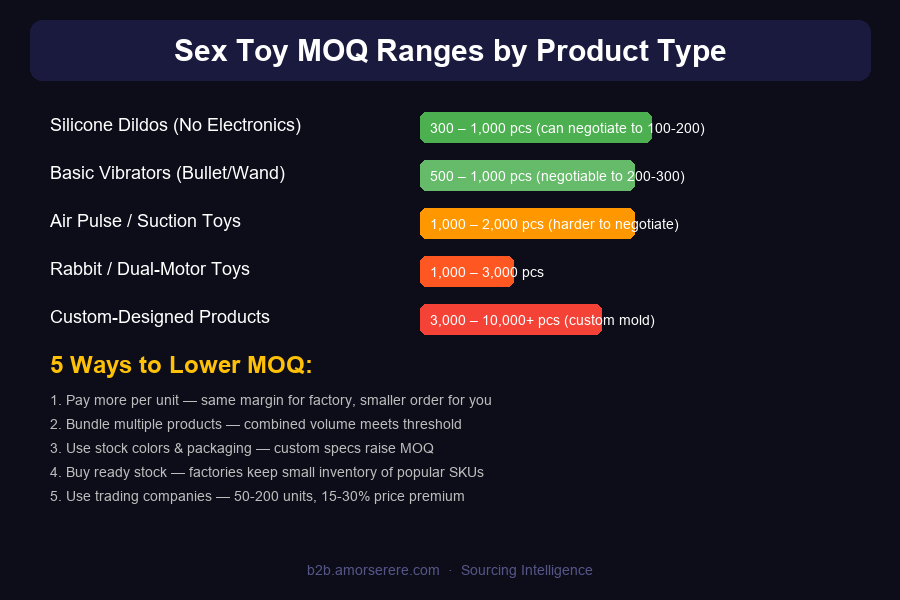
| Product Type | Typical MOQ | Negotiable? | Notes |
|---|---|---|---|
| Silicone Dildos (no electronics) | 300–1,000 | ✅ Yes — can reach 100–200 | Lowest MOQ category. Simple molding, no assembly. |
| Basic Vibrators (bullet, small wand) | 500–1,000 | ✅ Yes — can reach 200–300 | Electronics add assembly cost. Smaller components = less silicone per unit. |
| Air Pulse / Suction Toys (rose) | 1,000–2,000 | ⚠️ Difficult | Diaphragm pump assembly is complex. Higher defect rate on small runs. |
| Rabbit / Dual-Motor Toys | 1,000–3,000 | ⚠️ Very difficult | Two motors, complex PCB, multi-part molding. Setup cost is high. |
| Custom-Designed Products | 3,000–10,000+ | ❌ Non-negotiable | New mold = the MOQ is the mold amortization. You can’t negotiate past the math. |
The pattern: the more complex the electronics, the higher the MOQ. Simple silicone products give you the most negotiating room.
5 Tactics That Actually Work
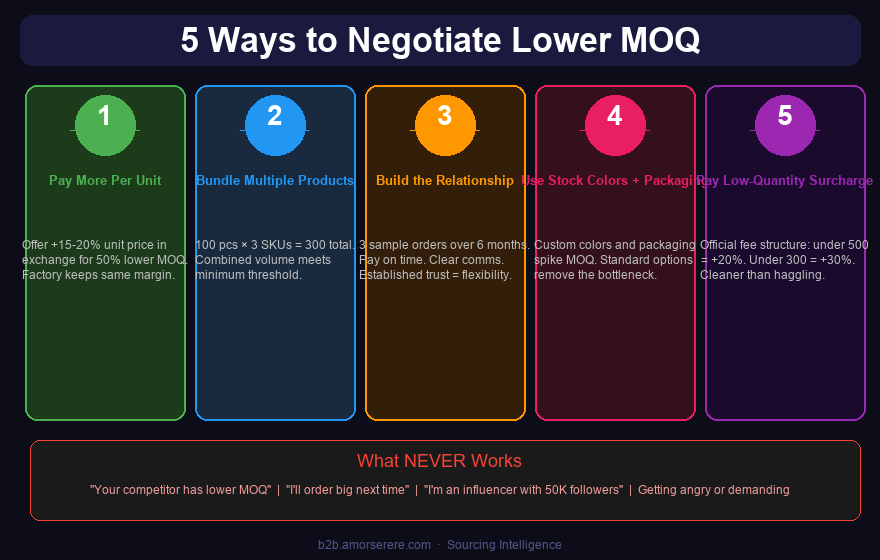
1. Pay More Per Unit
Offer +15–20% on the unit price for 50% lower MOQ. The factory keeps the same total profit — they just make it from margin instead of volume.
What to say: “I understand your MOQ is 1,000 units based on your margin at $5/unit. Would you accept 300 units at $6.50/unit? Your total profit is roughly the same.”
This works because it respects their economics. You’re not asking for a favor. You’re proposing math.
2. Bundle Multiple Products
100 units × 3 SKUs = 300 total units. The combined volume meets their minimum, and you get variety for your launch. Many factories are happier with a multi-SKU order than a single-SKU order — it demonstrates you’re a real brand, not a one-off buyer.
The catch: Each SKU typically has its own MOQ minimum within the bundle. A factory willing to do 500 total units might still require 100 minimum per SKU.
3. Build the Relationship First
Place 3 sample orders over 6 months before asking for MOQ concessions. Pay on time. Communicate clearly. Once you’re a “known buyer” rather than a random email, the factory is far more flexible.
Factories deal with hundreds of inquiry emails per week from people who will never place an order. A buyer with a track record — even of small orders — is treated completely differently than a stranger asking for favors.
4. Use Stock Colors and Stock Packaging
Custom Pantone colors require stopping the line to purge and remix. Custom packaging requires plate-making. Both spike the MOQ.
Instead: Ask what colors they’re already running this month. Use their generic box with a sticker label. You can always upgrade packaging on the second order.
5. Pay a Low-Quantity Surcharge
Most factories have an official surcharge structure they just won’t volunteer until you ask:
| Order Size vs MOQ | Typical Surcharge |
|---|---|
| 50% of MOQ | +20% per unit |
| 30% of MOQ | +30–35% per unit |
| Below 30% of MOQ | Usually declined |
This is cleaner than haggling. It’s their price, their terms, no ambiguity. Ask directly: “What’s your low-quantity surcharge schedule?” and see if the math works.
What Never Works
Factory sales reps hear these daily. They’ll smile politely and quote the same MOQ.
“Your competitor offered lower MOQ.”
→ They know 20 other factories. They know what competitors charge. If a competitor truly offered 300 when they’re asking 1,000, something is different — inferior materials, simpler product, higher unit price, or they’re lying to get the order and will hit you with “unexpected additional costs” later.
“I’ll order bigger next time.”
→ Every first-time buyer says this. The factory has zero evidence you’ll ever place a second order. First orders are evaluated on first-order economics only. If you want to build a long-term relationship, see Tactic 3 above.
“I have 50K Instagram followers.”
→ Followers don’t pay invoices. Purchase orders do. Unless you’re a celebrity with a verifiable audience in the millions, your social media doesn’t affect factory terms.
Getting angry or demanding.
→ You’re one of hundreds of inquiries this month. The factory doesn’t need your business badly enough to tolerate aggression. Respect goes further than pressure.
Small Buyer Workarounds
If factory-direct MOQ is genuinely out of reach, you have options:
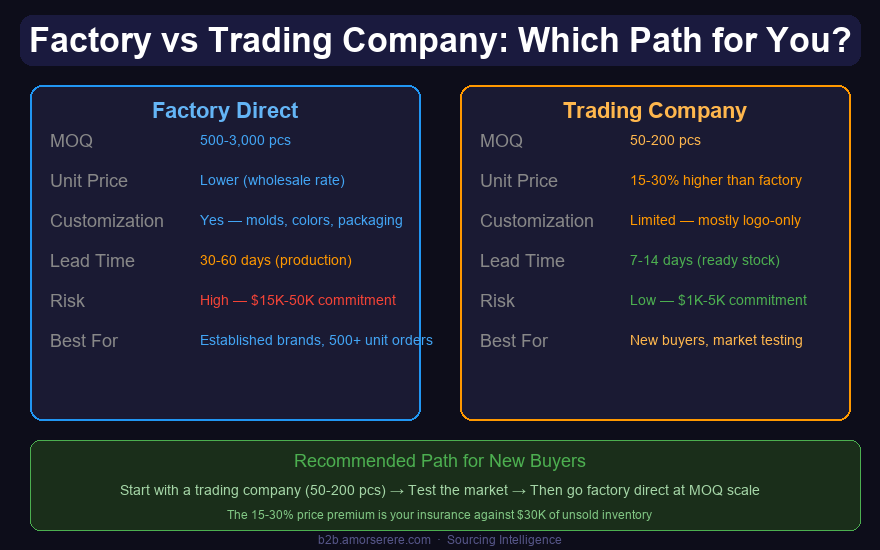
Trading Companies — MOQ 50–200 Units, 15–30% Price Premium
Trading companies aggregate orders from multiple small buyers to meet factory minimums. You’re not buying from the factory — you’re buying from an intermediary who already placed the large order.
Best for: First-time importers testing a market, brands that need 1–2 boxes of 50 units each to validate a product before committing to MOQ scale. This is the recommended starting point for most new buyers and pairs well with choosing between private label and white label models.
Factory Stock Inventory — MOQ 10–50 Units
Some factories keep small inventory of popular SKUs for sample and spot orders. You get factory pricing but zero customization — whatever color, logo, and packaging they have in stock is what you get.
Group Buying / Pooled Orders
Connect with other small brands in non-competing markets to combine your orders into a single production run. Requires coordination and trust, but the per-unit savings can be significant.
Real Startup Costs: What You’ll Actually Spend
Let’s be concrete. Here’s what it costs to launch with 3–5 SKUs:
| Cost Category | Low End | High End |
|---|---|---|
| Tooling / molds (3 SKUs) | $6,000 | $24,000 |
| Product inventory (500–1,000 per SKU) | $25,000 | $60,000 |
| Custom packaging (Tier 2–3) | $500 | $3,000 |
| Shipping + duties | $3,000 | $10,000 |
| Compliance / lab testing | $1,000 | $5,000 |
| Total (3 SKUs) | ~$35,000 | ~$102,000 |
The math for 1–2 SKUs at moderate MOQ:
| Cost Category | Estimated |
|---|---|
| Tooling (1 SKU) | $3,000–5,000 |
| Inventory (1,000 units) | $15,000–25,000 |
| Packaging + shipping + compliance | $5,000–10,000 |
| Total (1 SKU at MOQ) | $23,000–40,000 |
If this looks high: yes. Starting a physical product brand costs real money. Anyone who tells you otherwise is selling you a course. Our complete brand-building guide covers funding strategies, grant programs, and how to bootstrap without inventory risk.
The minimum viable launch: 1 product, 300 units through a trading company, no custom packaging (use stock box + sticker label), shipped to a 3PL. Budget: $5,000–8,000. Not glamorous, but it gets you data: does anyone want to buy this?
The One Question to Ask
When a factory quotes an MOQ, ask: “Is your MOQ driven by mold costs, material minimums, or labor?”
Mold costs = you can negotiate (paying more per unit compensates).
Material minimums = hard limit (the silicone batch size is what it is).
Labor (line changeover) = somewhat negotiable (pay the changeover fee yourself, about $200–500).
Knowing the constraint lets you negotiate around it instead of against it.
FAQ
50–200 units through a trading company, or 10–50 units of factory stock inventory. You’ll pay 15–30% more per unit than factory-direct pricing, but you avoid the $10,000+ commitment of a full production run. This is where most successful brands start.
At a trading company: yes. At a factory: almost certainly no (unless you’re buying stock and applying stickers yourself). Logo printing requires plate-making, which factories won’t amortize over 50 units.
Get quotes from 3–5 factories for the same product. If one quotes 500 and four quote 1,000–2,000, the 500-unit factory is either cutting corners, misrepresenting their capabilities, or quoting a lower MOQ to win the order (only to add fees later). The outlier is usually wrong.
Sometimes. After 2–3 successful orders, factories may lower MOQ for reorders — especially if you’re using the same mold and packaging. Always ask: “After our first order, can we discuss a lower reorder MOQ?”
MOQ is a starting position, not a rule. Understand the factory’s constraints, offer solutions that respect their economics, and remember: the best negotiation is being a reliable buyer they want to keep.