
Author: Linda Zhang, Date: July 7, 2026 Reading Time: 9 minutes
Introduction: The Freight Quote That Killed a Deal
A buyer from the UK once sent me an urgent email.
“Linda, I need 200 units by the 15th. Your product price is fine, but the freight quote I got from my own forwarder is $2,800. That’s more than the cost of the goods. Can you help?”
I asked two questions: “What method did they quote you?” and “What deadline did you give them?”
The answer: “Air express, next week.”
The forwarder—not wanting to lose the business—quoted the fastest possible option without asking the buyer whether “fast” or “affordable” mattered more. The buyer did not know there were other choices, so they almost walked away from the deal entirely.
Choosing the wrong freight method is the single most common reason first-time buyers overpay for their orders. It is also the hardest to catch because freight quotes arrive as a single number with no context about alternatives.
This guide explains the three main freight methods available to buyers importing adult wellness products from China—what each one costs, when to use it, and the one question you should always ask your forwarder before accepting any quote.
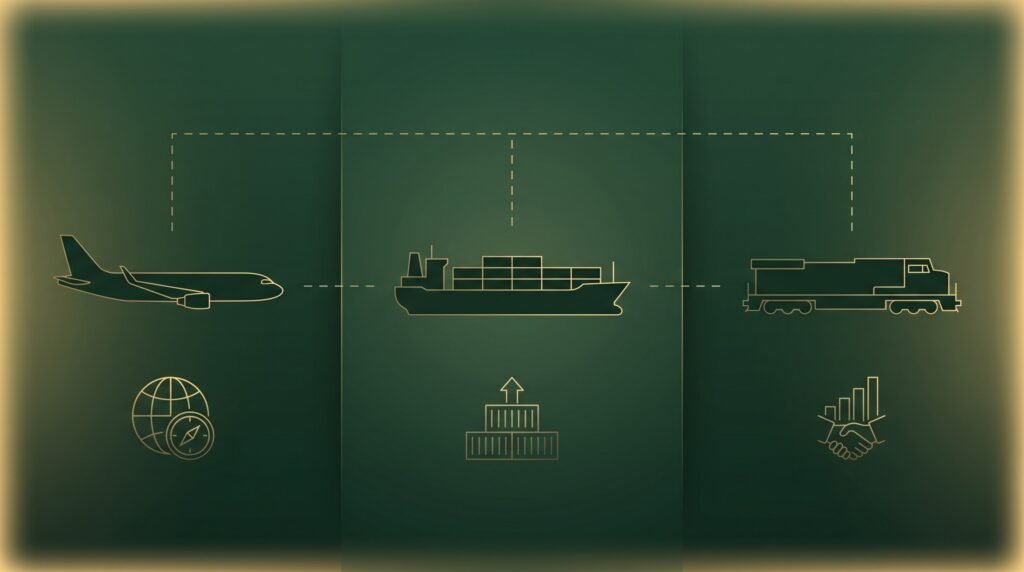
Part 1: The Three Methods at a Glance
| Air Freight | Sea Freight | Rail Freight | |
|---|---|---|---|
| Transit Time | 5–10 days | 25–40 days | 18–25 days (Europe) |
| Cost Level | $$$$ (4–15× sea) | $ (baseline) | $$ (1.5–2.5× sea) |
| Reference Range | 3–7/kg base rate, gateways | LCL: 80–180/CBM | 30–50% less than air |
| Minimum Volume | Any (even 1 carton) | 1 CBM or 200+ kg | 1 CBM or 200+ kg |
| Best For | Urgent orders, samples, lightweight goods | Bulk orders, heavy goods, non-urgent restocks | Mid-weight Europe orders, faster than sea, cheaper than air |
| Worst For | Large/heavy orders, tight budgets | Last-minute deadlines, small volumes | US/Australia routes (no direct rail link) |
Price references: Freightos 2026 Air Freight Guide, FreightAmigo 2026 Air vs Sea Comparison, DDPChain 2026 Rail Freight Report.
Part 2: Air Freight—Fast, Expensive, and the Default Trap
When to Use It
- Your order is under 100 kg total
- You have a hard deadline (launch date, event, regulatory window)
- Your client is paying a premium for speed
When to Avoid It
- Your order is over 300 kg
- You have 4+ weeks before the goods are needed
- Your product is heavy (solid metal, large silicone molds, batteries adding weight)
Real Example: 200 Units of a 400g Vibrator
- Total weight: 80 kg (200 × 400g, plus packaging)
- Cartons: 4 cartons at ~25 kg each
- Transit time: 7 days by air, ~32 days by sea
Here is how the industry comparison plays out at this weight level. According to Freightos’ 2026 air vs sea data, a shipment that costs roughly 195byoceanwillruncloseto1,000 by air on the same lane. That is approximately a 5× multiplier.
A buyer who pays air freight to get their goods in 7 days instead of 30 has made a conscious trade-off. A buyer who was never told sea freight exists has not been given a choice at all.
The One Question to Ask
When you receive an air freight quote, always ask: “What would this cost by sea, and what is the time difference?” If the forwarder cannot answer immediately, find another forwarder. They are either inexperienced or they are protecting their commission on the more expensive route.
Part 3: Sea Freight—Slow, Cheap, and How Most of the World Moves
When to Use It
- Your order is over 200 kg or 1 cubic meter
- You have 5+ weeks before you need the goods
- You are ordering non-seasonal items that can be warehoused
- You want to maximize your margin on the landed cost
When to Avoid It
- You are shipping samples or very small test batches
- You have a strict deadline in the next 30 days
- Your supplier is in an inland city far from a major port (the trucking cost to the port eats the savings)
The Costs Nobody Tells You About
Sea freight quotes typically show the ocean leg only. The true landed cost includes:
| Fee | Typical Range | Who Pays |
|---|---|---|
| Ocean freight | 800–1,500 per 20ft container | Buyer (in FOB/CIF terms) |
| Origin charges (THC, documentation, customs clearance in China) | 150–400 | Seller or buyer depending on terms |
| Destination port charges | 200–500 | Buyer |
| Customs duties and import VAT | Varies by country and product value | Buyer |
| Last-mile delivery (port to warehouse) | 300–800 | Buyer |
Rule of thumb: The ocean freight number on your quote is approximately 40–50% of what you will actually pay door-to-door. Always request an all-in DDP (Delivered Duty Paid) quote for comparison. It will look higher than FOB sea freight, but it eliminates the surprise fees that destroy your margin calculation.
Real Example: 600 Units of a 400g Vibrator (LCL—Less than Container Load)
- Total weight: 240 kg
- Volume: ~1.5 CBM
- At typical industry LCL rates (80–180/CBM, per Freightos 2026), sea freight for this volume sits in a predictable range most buyers can budget for comfortably.
- Transit time: 32 days (Shenzhen → Felixstowe, UK)
For a buyer with 6 weeks before their launch, sea freight is the clear winner—the savings compared to air translate directly into margin. A buyer who can plan ahead wins twice: lower freight cost and the ability to order in larger quantities.
Part 4: Rail Freight—The Europe Sweet Spot That Most Buyers Overlook
Rail freight from China to Europe is the fastest-growing freight method in B2B trade, and most first-time buyers have never heard of it.
When to Use It
- Your destination is in Europe (rail connects to Germany, Poland, the Netherlands, and beyond)
- Your order is between 100–500 kg—too heavy for affordable air, too small for a full container
- You need faster than sea but cannot afford air
When to Avoid It
- Your destination is the US, Australia, or anywhere outside the Europe-Asia rail corridor
- Your products are extremely fragile or temperature-sensitive (rail containers can experience wider temperature fluctuations than air or sea)
Real Example: 300 Units to Germany
- Total weight: 120 kg
- Air freight: 7 days
- Sea freight: 30 days
- Rail freight: 20 days
Industry data (FreightAmigo 2026, DDPChain 2026) consistently shows rail at 30–50% less than air freight. For a 120 kg shipment to Germany, that translates to meaningful savings—without the 30-day wait.
For a buyer who needs the goods before their competitor’s sea shipment arrives but whose budget cannot absorb air freight, rail splits the difference perfectly.
Part 5: How to Make the Decision in Under Five Minutes
Step 1: Know Your Numbers
Before you email a forwarder, calculate these:
- Total weight (product × quantity, plus 10–15% for packaging)
- Total volume (carton dimensions × number of cartons, in cubic meters)
- Deadline (when does the product need to be in your warehouse, not when do you want to order)
Step 2: Apply the Decision Framework
| Your Situation | Best Method |
|---|---|
| Under 50 kg, urgent | Air express or air freight consolidated |
| 50–200 kg, flexible timeline | Sea LCL or rail (to Europe) |
| 200–500 kg, Europe, 3 weeks | Rail |
| 200 kg+, any destination, 5+ weeks | Sea LCL or FCL |
| 2,000 kg+, any destination | Sea FCL (full container) |
Step 3: Always Get Three Quotes
One forwarder’s “best rate” is another forwarder’s “standard rate plus their margin.” Request quotes from at least two providers. When you compare, make sure both quotes include the same Incoterm (preferably DDP for a true door-to-door comparison).
Part 6: A Note on Adult Products and Freight
Shipping adult wellness products adds one extra layer to every freight decision: carrier acceptance.
Many logistics providers have varying policies on products in this category. Some accept them without issue. Others require them to be declared under specific HS codes (we recommend 9019.10 for electric massagers). A small number will not handle them at all.
At AmorSerere, we work with logistics partners who are experienced with our product category. This means no eleventh-hour rejections at the warehouse and no awkward conversations with freight agents who are uncomfortable with the shipment.
If you are using your own forwarder, ask them explicitly: “Do you handle personal wellness or massage devices with built-in batteries?” Do not use industry terminology until you have confirmed their acceptance policy. Once they say yes, provide the HS code and the UN38.3 battery test reports your manufacturer should have supplied.
Conclusion: Freight Is Not a Line Item—It Is a Strategy
The difference between an air freight bill and a sea freight bill is not just money saved. It is whether that money goes to a shipping company or to your next marketing campaign, your next sample order, or your profit margin.
The buyers who win on freight are not the ones who negotiate the hardest with forwarders. They are the ones who give their forwarder enough information to recommend the right method in the first place. A forwarder who knows your weight, your deadline, and your budget constraints can save you money that no negotiation could match.
Tell your forwarder what matters. Let them earn their commission by finding the route that serves you best—not the one that pays them the highest margin.
If you are sourcing adult wellness products and want a partner who handles freight coordination as part of the order, take a look at our catalog.
Related Reading
- How to Pay Chinese Suppliers Safely
- Import Regulations: US, EU, UK & Australia
- How to Negotiate Factory Pricing (Without Getting Burned)
Last updated: July 3, 2026